
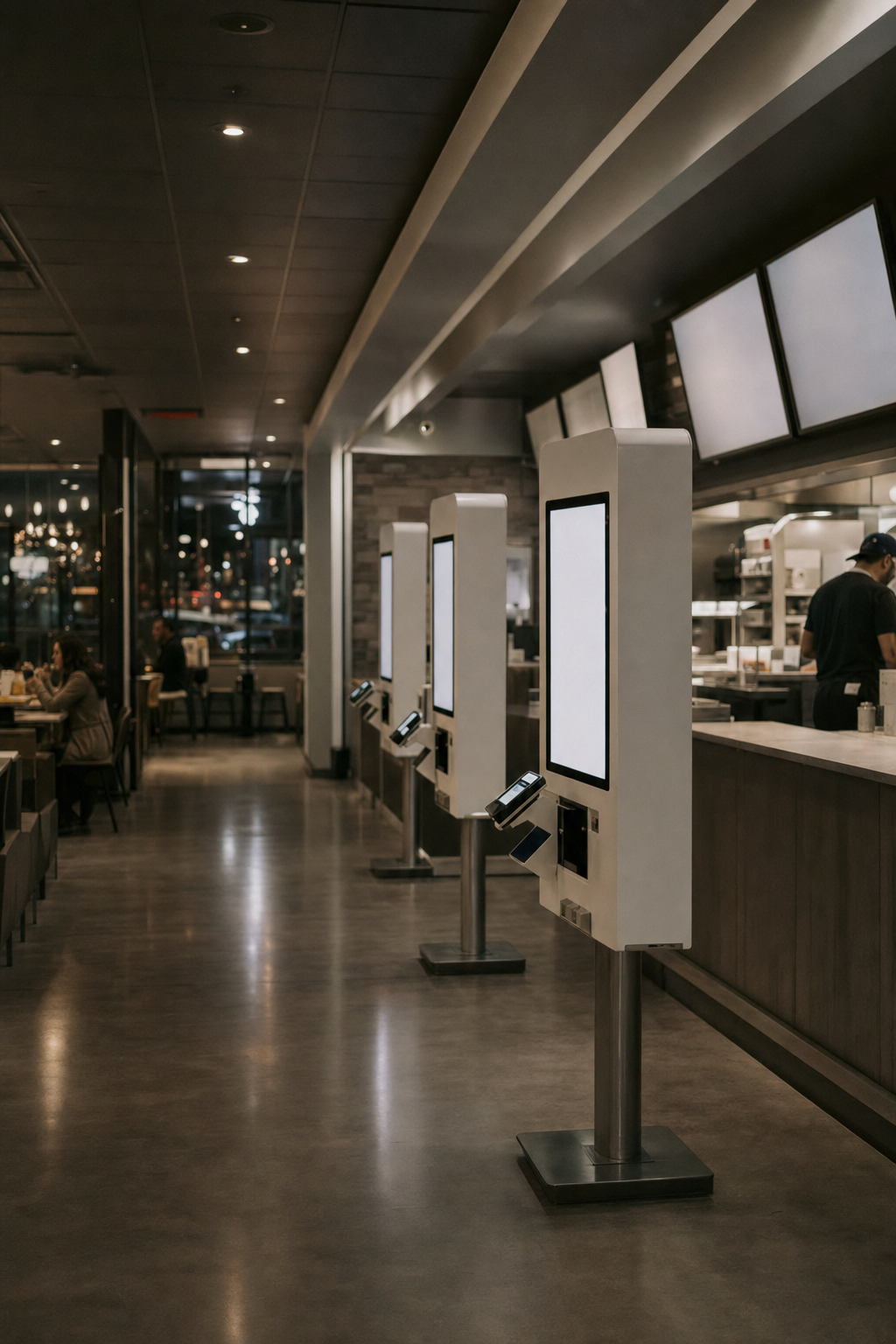
Is quick service the next retail media network?
Yes — QSR is already among the fastest-growing retail media verticals. A chain’s menu boards, drive-thru screens, kiosks and app impressions form an owned media network with something few others have: item-level proof of what every impression sold.
Retail media grew up in grocery and e-commerce, where retailers learned to monetise their shelves, sites and first-party data. The same logic is now moving into quick service — and analysts consistently rank QSR and food delivery among the fastest-growing commerce media surfaces. The reason is structural: a large chain operates thousands of locations, each with screens at the counter, in the drive-thru and on the kiosk, plus a loyalty app opened by millions of identified diners every week.
That is a media network by any definition. Most chains just have never run it as one.
What does a QSR retail media network consist of?
Every owned surface a diner meets on the way to an order — and just after it. Digital menu boards and drive-thru screens reach diners seconds before purchase. Kiosks and the app reach them mid-order, where a suggestion becomes a line item in one tap. The order-confirmation screen reaches them at the moment of peak commercial attention, when the decision anxiety is gone and the next visit can be seeded. Layered on top sits the loyalty data that makes every one of those impressions targetable and measurable.
Should chains sell the space or use it themselves?
Use it first, sell it second. The first-party value of the network — steering menu mix, launching LTOs, lifting average check — is available immediately and compounds with the chain’s own data. External monetisation (beverage and consumer brands, local services, entertainment launches) is real revenue, but it only commands premium pricing once the network can prove performance. Which points to the actual prerequisite:
“A retail media network is only as valuable as its proof. In QSR, the proof is the order — item by item.”
What has to be true before the screens become media?
Four foundations separate a screen estate from a media network:
- Central playout control. Every screen in every restaurant addressable from one system — by daypart, region, store or audience — not via USB sticks and franchisee goodwill.
- Clean first-party data. POS, kiosk, app and loyalty data unified around the diner and the item, so targeting and measurement speak one language.
- Closed-loop measurement. Impressions matched to transactions, so a campaign's report reads in incremental orders and check growth — not plays and dwell time.
- A creative system. Modular formats that adapt across boards, kiosks and app placements automatically — because a network that needs bespoke production per screen never scales.
These four are exactly the layers the operating core coordinates for quick-service networks — media infrastructure, data, measurement and creative systems running as one operating loop rather than four vendor contracts. Once that loop runs, the same screens serve two P&Ls: they sell more of the chain’s own menu today, and they become sellable inventory tomorrow.
Grocery needed a decade to learn this. Quick service gets to skip ahead — it already owns the screens, the data and the transaction. What it needs is the system that runs them as one.