
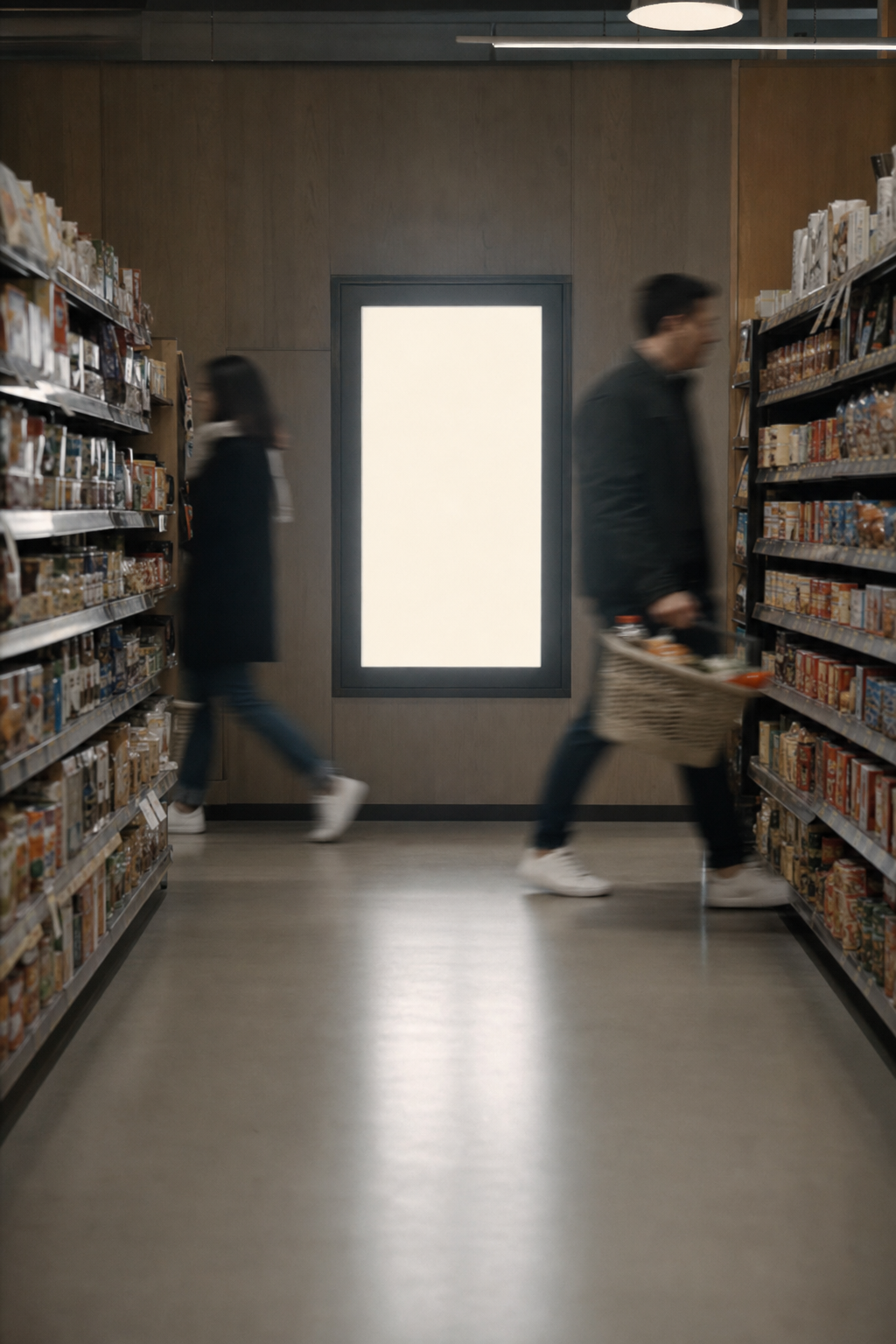
In-store retail media: the biggest screen network nobody runs properly.
Around 76% of purchases still happen inside physical stores — yet in-store media remains the least developed part of most retail media networks. The retailers that treat their stores as owned media infrastructure will win the next cycle.
Retail media grew up online: sponsored search, on-site display, audience extension. But the audience was always somewhere else. It was in the aisle, holding the product, seconds from a decision. In 2026, analysts from Coresight Research and others consistently point to in-store as retail media’s next major growth frontier — precisely because it has been left behind.
What is in-store retail media?
In-store retail media is paid and owned content delivered on surfaces inside the physical store — digital screens, shelf-edge displays, audio, and increasingly the shopper’s own phone in “store mode.” It reaches customers at the shortest possible distance to purchase, in an environment the retailer fully controls.
The research backs the placement: studies show 58% of shoppers actively notice in-store displays, and nearly half report that they influence purchase decisions. No other channel gets that attention at that moment.
Why has in-store media lagged behind online retail media?
Because screens got treated as an IT project, not a media business. Hardware was bought store by store, content was managed by whoever had time, and nothing connected to sales data — so nobody could prove what the screens actually did.
The result is familiar: a chain that technically owns thousands of media surfaces, running the same static loop in every store, with no targeting, no dayparting, and no measurement. Owned — not orchestrated.
“A screen without transaction data behind it is decoration. A screen wired to the till is media.”
What does it take to run in-store media as infrastructure?
Treat the store network like a broadcaster treats a channel — with programming, playout, and ratings. In practice that means four layers working together:
- Distribution. Reliable playout across every screen in every store — remotely managed, monitored, and proof-of-play logged.
- Content systems. Modular creative that adapts by store, region, season and stock level — built once, deployed everywhere.
- Signals. Real-time inputs — inventory, weather, time of day, local events — deciding what plays where.
- Measurement. SKU-level sales data per store, matched to what was on screen, so every campaign is validated at the transaction.
How should retailers prioritise in-store media in 2026?
Start from distance to purchase, not from hardware. The screens closest to the decision — shelf edge, category entrances, checkout — carry conversion content and command the highest value. Screens further out build awareness and route traffic. Every placement gets a defined job, and every job gets measured against sales.
This is how the operating core treats media infrastructure: not as a screen rollout, but as one system in a closed loop — where what plays in the store is decided by data, and what sells in the store decides what plays next. The store was always the biggest media channel in retail. Now it can behave like one.