
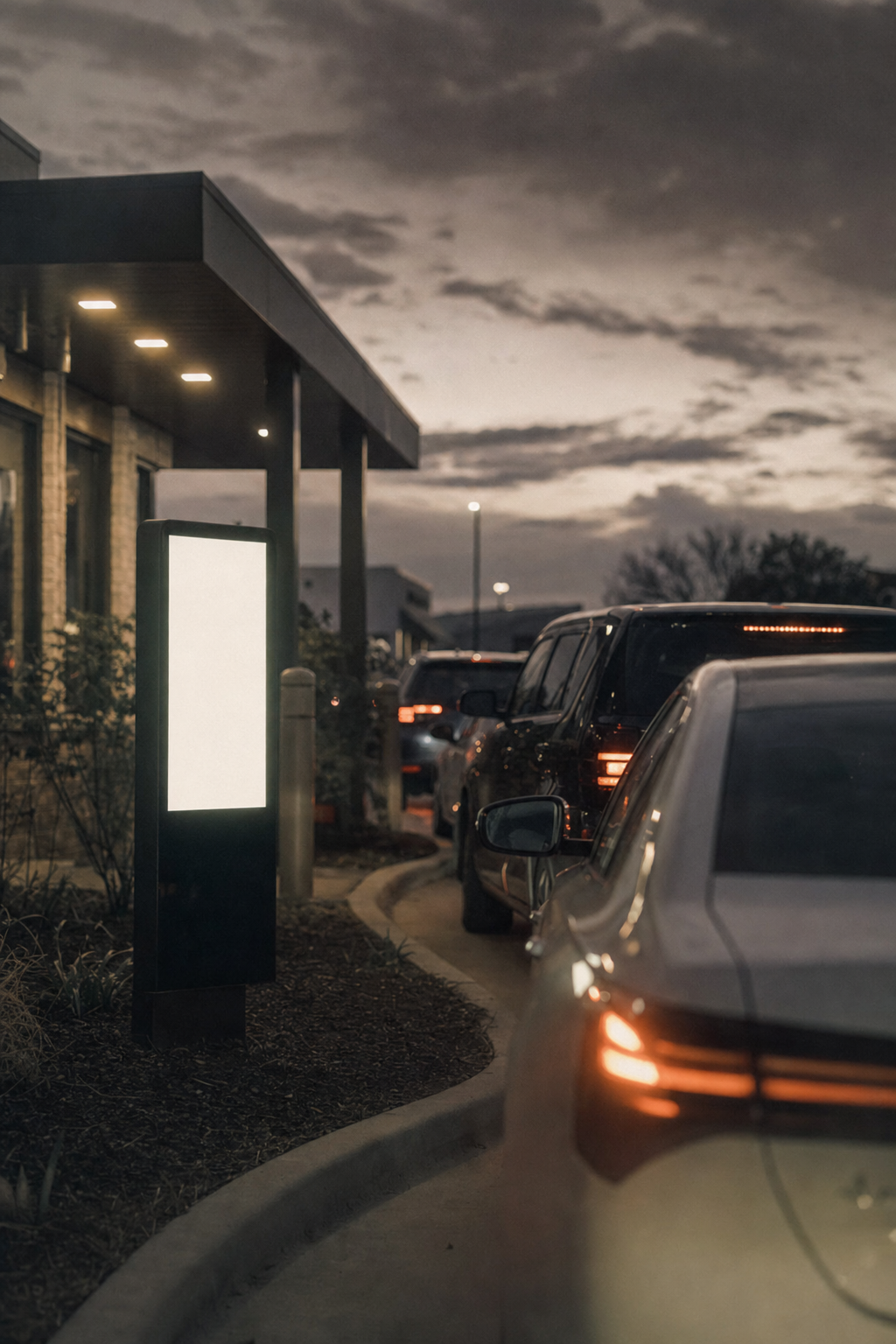
How do you actually improve drive-thru throughput?
The average drive-thru visit now takes around 5 minutes 35 seconds; lanes using AI voice ordering run closer to 3:53. But throughput is not a single fix — it is the compound result of menu design, screen content, forecasting and staffing working as one system.
The drive-thru remains the biggest revenue lane in quick service — and the most contested. Industry drive-thru studies for 2025 show visits down 5–8% year over year and order accuracy slipping to 87%, even as chains invest in dual lanes, AI voice ordering and mobile-order pickup. Speed alone is no longer the scoreboard. The lanes that win move fast, get the order right, and grow the check at the same time.
What is a good drive-thru service time in 2026?
Anything meaningfully under the ~5:35 industry average is competitive; the best-performing lanes — typically those pairing AI voice ordering with tight kitchen sequencing — complete a visit in under four minutes. But the more useful metric is throughput per rush hour: cars served in the fifteen minutes that decide the daypart. A lane that averages 4:10 all day but stalls at 7:00 during the lunch peak is losing its highest-value orders to the chain across the street.
That is why throughput is a forecasting problem before it is a staffing problem. If you know, from item-level order history, what Tuesday lunch looks like at each location, you can pre-position labour, prep and menu content before the queue forms.
Why does the menu board matter more than the timer?
Because most drive-thru delay is decision time, not kitchen time. A cluttered pre-sell board slows every car behind it. The fastest chains treat the outdoor screens as throughput infrastructure: fewer choices at peak, bolder combos, and pre-sell content that gets the order half-formed before the speaker post.
“Most drive-thru delay is decision time, not kitchen time. The screen is throughput infrastructure.”
Which levers move throughput without hurting the check?
The operators making real gains work five levers together, coordinated by order data rather than run as separate initiatives:
- Daypart menu simplification. Peak-hour boards show fewer, faster-to-assemble items — restored to full range off-peak, automatically.
- Pre-sell sequencing. The approach screen primes one decision (the combo, the LTO); the order screen confirms and upsells with a single suggestion.
- Demand-matched staffing. Daypart forecasts built on item-level POS history set labour and prep by location, not by region-wide averages.
- Order confirmation screens. Confirmation cuts remakes — and every remake avoided is 90 seconds returned to the lane.
- Loyalty-linked recognition. App identification pulls a likely order before the greeting, collapsing decision time for the highest-frequency diners.
What closes the loop?
Measurement at the transaction. Every order carries a timestamp, a lane, a menu-board state and a basket — which means every throughput experiment can be validated against real outcomes: cars per hour, accuracy, average check. This is how the operating core approaches the drive-thru: not as a speed problem to be timed, but as a closed loop where screens, forecasts and staffing learn from every order they serve.
Chains that run the lane this way stop trading speed against check size. They get both — because the same data that shortens the queue also tells the screen what to sell next.