
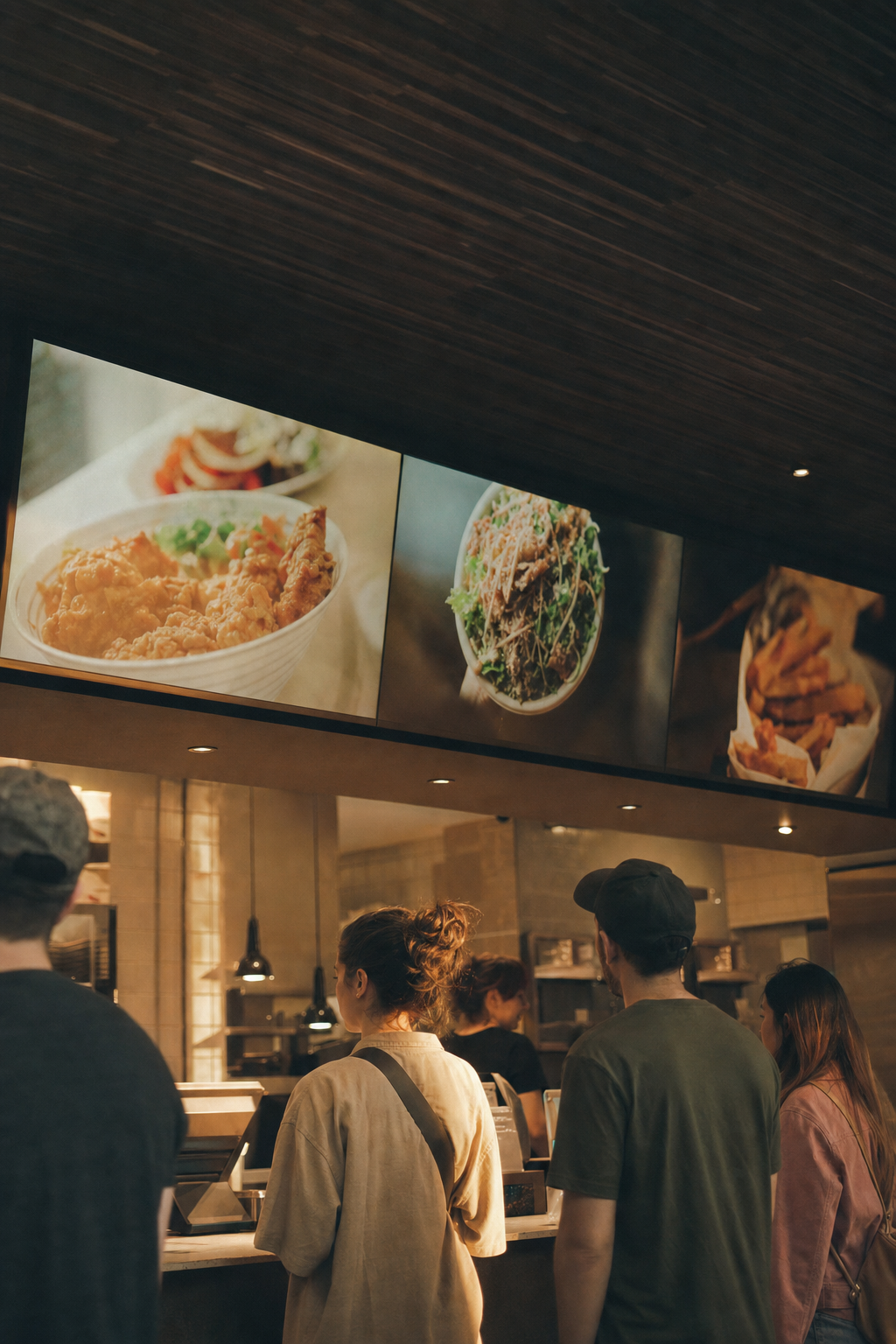
What is the real ROI of digital menu boards?
Digital menu boards typically lift total sales by 3–5%, lift promoted items by as much as 38%, and recover their cost through print savings alone. But the hardware is the smallest part of the return — the system behind the screen is what compounds.
Most quick-service chains have already made the capital decision. The screens are up — above the counter, at the drive-thru, on the kiosk. What separates operators now is not whether they own digital menu boards, but whether those boards are run as media or left as digital posters.
The difference shows up directly in the P&L. Industry studies put the baseline sales lift from digital boards at 3–5%, with promoted items seeing uplifts of up to 38% and strategic upsell prompts increasing average transaction size by as much as 30%. A screen that rotates the same static frames all day captures almost none of that.
How fast do digital menu boards pay for themselves?
Usually within two to three years on cost savings alone — before counting any sales lift. Eliminating printing, shipping and installation labour for static menu updates saves a typical location tens of thousands per year. Every price change, LTO launch and daypart switch that once required a truck and a ladder now happens centrally, in minutes, across the whole network.
That is the defensive case. The offensive case is bigger: a digital board is the last message a diner sees before deciding what to order. No other media placement in the business sits that close to the transaction.
Why do most chains capture only a fraction of the return?
Because the screens are disconnected from the data. In most networks, the menu board is managed by operations, the promotions calendar by marketing, and the item-level sales data by finance or IT. The board shows the same content at 8 a.m. and 8 p.m., in a location selling out of chicken and one drowning in it, on a rainy Tuesday and a sunny Saturday.
“A digital menu board is the last message a diner sees before ordering. Running it without order data is running it blind.”
What turns a menu board into a growth engine?
Closing the loop between what the screen shows and what the till records. When item-level POS data feeds back into the content system, the board stops being signage and starts being a decision engine:
- Daypart switching. Breakfast, lunch, snack and late-night menus rotate automatically — with pacing tuned to what actually sells in each window.
- Margin-weighted placement. High-margin items and combos earn the hero positions, validated weekly against menu-mix data rather than gut feel.
- LTO acceleration. Limited-time offers go live network-wide on launch morning, and underperforming creative is swapped mid-campaign, not after.
- Local responsiveness. Weather, inventory and local demand adjust what is promoted, store by store, without franchisees touching a thing.
- Measured, not assumed. Every content change is read against the transaction, so the next rotation is an informed decision rather than a redesign.
This is the model the operating core works from: the menu board as one node in a closed loop that runs from strategy and creative through the screen to the order — and back. Every transaction sharpens what the network shows next.
The ROI question, then, has two answers. The hardware pays for itself on logistics. The system pays for itself on every order it nudges — and unlike the hardware, that return compounds.